
On-Demand Grinder Design
November 16th h 2016 Author: David Schomer, When all the factors are in control, machines are clean and temperature stable, coffee is fresh, barista techniques are solid, and grinder burrs are sharp, my baristi on the bar are mostly trying to control the flow-rate of the espresso oozing into the cup. To truly capture the fragrance of the ground coffee in a shot of espresso it must flow at a very precise rate into the cup. Ideally we want to extract about one ounce of crema in 26 to 29 seconds. And, the new generation of PID controlled espresso machines have revealed the exquisite sensitivity of the process to the speed of water passing through the ground coffee. Within our range of shot times we see dozens of different espresso profiles from the same blend. On the faster side, around 26 seconds, the caramelized sugars from the Indian coffee may come forward, a little slower, 28 seconds for the ounce of crema, and Ethiopian coffees may dominate the cup with a chocolate/umami. Shots that time out less than 25 seconds, “fast pours” are sour astringent at Vivace and shots that take longer than 30 seconds, “slow pours” may be hollow or have a bite to them. After 28 years of brewing espresso I am more fascinated than ever with the beauty and complexity of this method. For the expert baristi all over the world this is not big news. They have also learned that with the new temperature stable PID espresso machines, the flow-rate is what we must control to capture the fragrance of the coffee into the cup. And, we all struggle to control that factor. To control the flow-rate the grinder must produce the same particle distribution, and quantity of ground coffee each time we grind for a shot. Right now there is no grinder being made that can do this. Essential to artisan extraction is the practice of grinding each shot freshly. Commonly called “on-demand” grinding. At Vivace we have been grinding to order since 1988. This practice is now common to baristi from New Zealand to Taiwan, trying to make the finest shots possible. Although we now have stable espresso machines, the world-wide artisan espresso revolution does not yet have a grinder. Many on-demand grinders have been rushed to the market. They are simply modified, old style Italian grinders with the dosing hopper removed from the front. But to grind each shot individually, with a perfectly uniform grind, and dosage accurate to 1/10th of a gram, requires the grinder to be completely redesigned for this purpose. Many companies have placed a cone , or a vertical chute, where the old Italian dosing hopper used to attach to the grinder. In these machines the ground coffee must travel horizontally through some sort of chamber to the delivery cone or chute. This creates a machine with pre-ground “chambered-coffee” trapped within it. You cannot control the flow rate of the espresso if any ground coffee is trapped within the grinder. The on-demand grinder must dose straight down into the PF without the powder touching any metal surface.  This DRM grinding head clearly shows the chamber that traps about 6g of ground coffee on the way to the doser.
  Here we see the Anfim SP 450 without the doser cone. This grinder is being sold as an on-demand grinder but chambered pre-ground coffee equals almost 18g. The chambered coffee affects extraction in two ways. The first risk is ground coffee sitting in the machine, warm, and going stale. When it sits it also loses moisture. A dryer powder needs a finer grind. So, if it goes into your shot the dryer powder will offer less resistance to pressurized water, and the shot time speeds up. (Our window for a great espresso right now is 26 to 30 seconds to extract under one ounce (25ml) of crema. If the shot takes longer, flavor can go hollow, bitter, or sour. However, caffeine content is higher. The fast pours, under 25 seconds, are sour astringent, and the customer doesn’t even get the full caffeine. We always pitch the fast ones, serve some of the slow ones if they get the proper hang…at any rate my baristi are throwing out shots because the flow rate is too fast or too slow). The current crop of on demand grinders also face major difficulties getting the powder to the PF with out altering the composition between fines and the coarse flakes.
 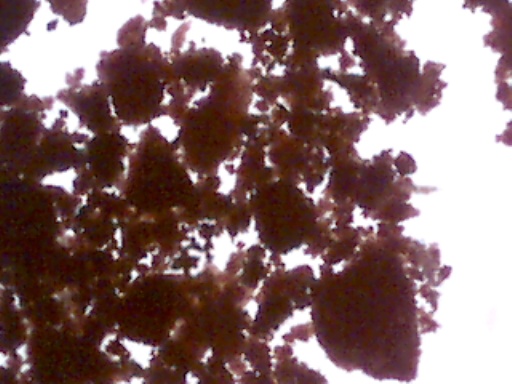 Here is a micro=photo of the complete powder mix from a conical burr set. Fines are evenly distributed within a matrix of larger particles. As the coffee slides down into the PF static may affect its particle distribution. The static pulls the fines out of the tumbling mix because they have less mass, they are lighter than the bigger flakes.. What we need is true fidelity to the original mix of fines and coarse particles exiting the burrs.
  Here is what happens as ground coffee is allowed to spray into the doser. Static electricity had caused finer particles to cling to the metal.
  This is a micro-photo of the particles that were clinging to the cone. Note it is predominately the fines. In conical grinding systems any static-electricity field the powder passes through traveling to the PF will affect the fine particles more than the larger flakes. (Conical burrs first grip the bean in the large fins and squeeze until it shatters, this produces particles of all shapes and sizes, including the smaller ones, called “fines”. Then, the bean is sheared to a consistent flake size with the finer teeth on the bottom half of the conical burr. But the fines slip through. Flat burr grinders are the choice for many baristi and grinder manufacturers like Mahlkonig, precisely because they feature more consistent flaking of the bean. It is true that conical burrs, producing fine particles, can make flow-rate control more difficult. However, the fines contribute much more flavor and a heavier mouth-feel in the cup and have always been our choice at Vivace despite flow-rate challenges). In the above picture you can see what happens if the coffee sprays out of the chamber, the fines separate and cling to the cone. And, lacking fines, the espresso pour speeds up, and the coffee thins out as well. To solve this the powder requires a gentle consolidation coming out of the chamber. This way the coarse flakes trap the fines in their original matrix. Static can’t separate out the fines when they are imbedded gently in the larger flakes. Consolidated coffee does not cling to the cone.
  Here is a simple cross-wire gate to prevent spraying coffee grounds by consolidating the powder with gentle back-pressure. Mazzer likes this solution and we employed it on the DRM as you can see. In theory, the wires should slow down and consolidate the coffee powder gently. However, with our roast, it worked poorly. True we did not have as many cling problems, but the stream of ground coffee could back-up making cakey blocks of ground coffee drop into the PF. If the coffee backs-up, the residence time of the powder in the burrs increases. The beans re-grind and become finer. Flow-rate control, our number one concern, is again destroyed when the shot seizes up. And, you can’t simply adjust for a coarser grind, each dosage of the powder will be different. After a couple of years we gave up on the cross wire gate. Back-ups were occurring way too often. We had another interim solution fail, and then arrived at this, the chain gate. ( Btw, if you are wrestling with a Mazzer caking on you, tear out the wires, and just hang a strip of scotch tape in front of the port, and see how you do. If it’s still cakey, softer tape for less resistance…)
  At Vivace we tried this stainless steel cable chain gate on the entry to the doser cone. Sized at 1.5mm links separated by 2mm beads, it makes a perfect curtain to just consolidate the grind particles a bit, but not too much. Using the chain gate, we never have cakey coffee, but we are getting some cling on the cone as summer turns to autumn. We are running a fleet of 14 grinders and man do my baristi have to dance to try to maintain a perfect flow-rate while these issues affect the ground coffee consistency. They must always be conscious of the condition of the chambered, ground coffee within the machine. If it has sat too long, the barista must purge 6g out of the chute. And, if we get any cling we need to brush it out of the cone very quickly. We can’t lose the fines or the pour speeds up and thins out. They have a teeny cling brush. But the damage is done to the powder even if you brush the cling into the PF because the distribution of the fines in the mix has been altered. Looking at the pour under the bottomless PF will reveal the imbalance in the powder by having the pour favor one side or the other. With perfect powder the pour is always dead center under the PF. You know it’s beginning to remind me of the dance we used to do to get the machines to be more temperature stable. I remember we called it “temperature-surfing”. And the materials used in machine manufacture included porous brass they used for the PF and the group head. That stuff would trap oils and go rancid quickly. We had elaborate tool kits including green scrubber pads to clean the brass every 40 minutes of operation. Well, this grinder thing is beginning to feel like those old days before PID and stainless steel. We are getting tired of the dance to overcome equipment that is not made to grind-fresh for each shot. We all rosed our vices then, demanding temperature stable machines. It is time for artisan baristi all over the world to demand a grinder designed for us. However, if I am going to complain it is better to bring something to the table. I have found a design, the Sette (made by Christian Etzinger for Baratza) is a home grinder that solves the chambered coffee problem and the particle drift problem perfectly.
  Here we see the jet of ground coffee shooting out of the bottom of the grinding head in the Sette. Christian has his delivery mechanism attached directly to the bottom of the conical-burr set. But the coffee doesn’t tumble out it is impelled by an engineered disc with indented ramp areas. The coffee shoots out in a jet. The blades consolidate the particles and accelerate the stream of coffee so the metal collar it passes through cannot affect it even if it picks up a static charge. Making coffee on this grinder I always hit my flow rate. An experience I would like to have at Vivace. He has told me that he will come out with s commercial grinder, made to grind by the shot, in 2017. An on-demand grinder must also produce the exact dosage with each shot. Timers that run the machine for a set period of time are not accurate enough. To get a consistent dosage amount the grinder must shut off when the desired dosage weight has been reached.