
David's Blog
Culture of Excellence-business structure
Owners and Managers,
In the previous post I mentioned that of course, to achieve a culture wherin’ staff are truly excited about your business, it is necessary to remain fairly small and tightly focused. In an artisan business it is the passion of the owner that is the seed that can grow into a true culture of excellence… but only if it is nourished and protected while it grows.
In my experience a person that is passionate about coffee might not be able to handle the mind numbing detail necessary to run a coffee business and still maintain that initial passion. They will wear out trying to handle accounting, payroll, taxes, inventory, store management, scheduling…and on and on…Business administration is a separate skill from creating beauty and inspiring others to follow your dreams. So if the business is too small the owner will burn out trying to do everything themselves. If it is too big the owners passion will be diluted through intermediaries that conduct training for them. For us the Goldilocks Zone is three stores and a roasting plant.
So let’s analyze Vivace for clues why my staff and myself can remain fresh and excited after 32 years of doing this.
First I stop in at all three coffee bars, and the roasting plant, daily. I show up and make sure equipment and techniques are up to par. I taste a lot of coffee with them. And I get excited with them to see beautiful latte art and perfect pours when they come out … Staff know this and it keeps them sharp and excited to excell at the art. So, in general, the size of the business is important. If it is too small you cannot afford bar managers and accountants and you will eventually fail. If it is too large you cant keep up with staff performance and training personally and the excitement gets watered-down.
Bar Management
I have a general manager with 18 years of experience, and a bar manager (also 18 years with VIvace), dedicated mainly to our Alley 24 location. They protect me from the daily blizzard of details required to run the bars. I totally trust them to handle the shops and they have meetings with me weekly.
Accounting
My partner handles this as her main responsibility. She has one professional accountant to assist in her department. This area also includes payroll and taxes.
Macchinesti-the machine specialist.
For all the coffee equipment, especially grinders, I personally maintain them. On the espresso machines, major repairs are usually delegated but “tuning” the temperatures and pressures, and handling small issues like replacing group gaskets, is done by myself. And, as I have mentioned making this my immediate priority when I visit reinforces my stated drive for perfection.
Training
This is my primary responsibility. I’m directly teaching fundamentals such as flow rate control, distribution and dosing, rinsing and machine cleaning, milk steaming and latte art. They see me monthly for the first few years at Vivace. When I personally teach them this culinary art the message is clear-Vivace is an authentic artisan business. The coffee matters.
We have one additional dedicated trainer for extraction fundamentals whose responsibilities also range into line management, and alternative milks. Also, we have a dedicated latte art trainer.
Training is where it all happens…we share the frisson of excitement at creating and tasting perfect shots. And we share the thrill of each employees first success pouring hearts, rosettas, winged hearts and other patterns as they learn them. This year some staff that have been with me for eight years were thrilled to free-pour Christmas trees for our lock-down holidays. (I love it when long-run pro baristi are still excited). And training each one keeps me fresh also because each person is a unique puzzle to figure out how to best teach them the skills required while instilling ownership of this art form. And, as baristi get better we honor their work with our online latte art gallery.
So the takeaway from this short series I’ve written is that authentic passion is required in the owner to be the seed of the culture of excellence surrounding your company. And that passionate person has to be protected by dedicated partners and managers to survive the realities of small business. The size of the company has to be small enough for the owner to personally check in daily at all stores, but big enough to have professional bar management and accounting to run the machine that is a business.
And, an artisan espresso business, once established, is a tough little entity, financially stable through the ups and downs of economic cycles. And it brings discerning and intelligent customers into the door which serve to reinforce staff interest in the art.
Culture of Excellence-the seed
Owners and Managers,
Of course, any business striving to hire and motivate employees to take pride and become personally involved in the company charter, has to be fairly small. The seed of the culture must be the passion of the owner. An authentic passion for coffee that stands the test of time, and the rigors of small business, must be present in the owner. There is no hiding.
Staff members are like family in one important aspect: they can see your true priorities through your actions over time. You are key to their livelihood and they will keenly zero in on your true priorities whether or not you know them yourself. They will give you what you prioritize. It’s an easy thing to say “we will make the best coffee possible every day!” But to succeed it is a classic case of actions speaking louder than words.
For example, if you visit the shop and staff says the grinder seems to be heating up and shots are coming out thin and whitish. But you are busy heading to an important branding meeting. “Ill try to get to that as soon as I have time” Staff will quickly surmise that marketing is more important to you than excellent coffee. As owner you have missed a chance to be authentic to your charter: making great coffee. Staff are not stupid, they know as owner you are very busy. However, if you pull that grinder immediately and change the burrs (or replace it with a back-up grinder) they will believe in you as having authentic passion. In the long run this is much more important than marketing.
You cannot fake passion because running a small business is too tough and will wear you down to your true nature quickly. But if your true essence is passion for coffee, that passion can create a wonderful business model containing many hidden treasures.
On your side of the counter having a reputation for authentic passion attracts intelligent, sensitive applicants to work there. In the US right now, many happening young people want to dedicate their time and energy to something beautiful. An authentic artisan business has a deep meaning to the people that bring it to the world. It is more than just chasing the almighty dollar. So, staffing is easier. Great people apply all the time.
On the other side of the counter, quality attracts a discerning customer. It sounds elitist of me but over time I see a correlation between possessing a discerning palate and intelligence. (The opposite is not necessarily true, I know lots of brilliant folks that are simply not interested in quality food or drink.) In espresso preparation artisan preparation is almost impossible to find, so the sensitive customers are very appreciative and respectful of the staff and the gorgeous coffee they can create. This appreciation manifests in better tips and excitement over the drinks trained staff can create. This excitement from the customers makes an artisan espresso business an exciting place to work. Although artisan espresso preparation is very difficult,if you can pull it off the customers will be exceedingly loyal, and your business will stand the test of time. (People will cling to their coffee even when money gets tight. We prospered right through a the sub-prime mortgage recession, and are going to come through our first pandemic.)
So as a business model, artisan espresso brings in great applicants to work there and great customers to appreciate them and that fosters an environment wherein staff can remain happy over time.
Culture of Excellence-initial training
Owners and managers,
In the second installment of this series I mentioned that our interview process includes an hour of training on the espresso machine with myself. I can learn a lot more about an applicant going through the espresso training process than I can by sitting and chatting. I’m looking for attitude expressed by physical “tells”, artistry and native talent, and their learning style. And of course every action is a two way communication. The fact that the owner dedicates his time exclusively to the act of teaching to be an artisan barista speaks a lot about the priorities of the company. And it gives all staff a way to get to know me.
And, I can make my coffee for them. I learn a lot by their reaction when we taste results together. It’s one thing to tell them that the espresso is ultra sensitive to flow rate, fast pours are sour, slow pours can be hollow, sour or bitter. But tasting a 20 second extraction really drives home the point, it’s sour astringent, so never serve it. In the states a lot of folks do not drink straight shots. So one trainer trick I employ is for them to taste the sour/astringent shot then a perfect shot right after. Most people will perceive the “god-shot” as much sweeter and richer after their palate has been assaulted with sour crema.
We run through settling and distribution technique, and dosing manually up front. I emphasize that distribution is always a focused moment and over the years it is crucial to maintain a student attitude, never dashing it off without paying attention to the process. A big tell here would be impatience with the process being expressed by rushing or excessive noise being generated- the hands revealing frustration or a “you’ve got to be kidding” attitude. Body language can be quite revealing. In a future great barista, this part of the training is always fumbly and cautious out of respect for the level of artistry Vivace has achieved. A “know it all” applicant will always try to appear really confident and cool. (This is not an automatic deal breaker with me but it is more difficult to teach someone that thinks they know it all already.)
Next we focus on rinsing the group head and cleaning techniques. This requires very precise timing. During this part of the training I mention that running an espresso bar to our standards is a series of small precise timings. For example, the shots are quite perishable and must be combined with the milk instantly at the moment that the milk is perfect. Rinse timing gives me a good window to see if precision is in their skill set.
Next we practice milk steaming and a latte art intro. I’m looking for some kind of enthusiasm or appreciation of beauty. At this point their attitude and appreciation towards the process is much more important that initial skill levels. I can teach skills but the appreciation of the coffee, and their own artistry or lack of it is innate to that person. And, nothing reveals this as well as an hour of training.
Next we will dive into the structure of a business that supports, or erodes, a culture of excellence.
Culture of Excellence- the interview
Hello Owners,
I’m taking a forensic dive into an existing culture of excellence at Vivace over several posts. During this series of posts we can look at all the components of our successful model. Although it works-Vivace staff are thrilled to make our customers happy with our coffee, it is infinitely complex. I’m intuitively able to do this but it’s still magic at it’s core.
As always, my aim is to advance caffe espresso as a culinary art. Critical to this for the professionals is to develop a staff that is professional, informed on techniques, and motivated to create this complex culinary art. After 32 years I find that the enthusiasm and love coming from the younger people preparing espresso at Vivace to be essential but also it’s own reward. Teaching them and watching their excitement over their first latte art keeps the whole thing fresh for me. As Brian Fairbrother advised me and Geneva in the early ’90’s “We will get older and the staff will remain young.” (Geneva and I march on but we lost Brian in a bicycle accident years ago).
On to the interview process at Vivace…
We schedule a 20 minute window for each applicant. Owners and managers are present for each interview to emphasize the importance of considering a new person to work within our organization. Personally i always lead off by asking “why do you want to work at Vivace”? If they say because the people I meet when I order coffee seems so happy and skilled I quickly springboard into a broader discussion of Vivace culture.I explain that their is steel behind their smiles. It is a benevolent meritocracy.
Other standard Q’s include whether they are a natural morning person or like to work late into the evening. We want to work with peoples natural inclinations whenever possible. Then it’s free form discussion, always live if possible. (Covid era zoom interviews have clearly demonstrated that you get a much better feel for the applicant when you can sit down in the same room!)
If they make it past the interview with all of us present, then they spend an hour training on the espresso machine with myself as the second half of the interview. I watch for “know it all” types, and physical aptitude with techniques. I also make them a macchiato or if they are familiar, a straight shot. (Caffe espresso is an aquired taste.) (more…)
Culture of Excellence-the resume
Hello Shop Owners,
When I was on the circuit lecturing at every Coffee Fest in the mid ’90’s one of my most popular seminar topics was how we hired, trained, and inspired baristi to make artisan espresso. Broadly, creating a Culture of Excellence is an infinitely complex affair, but it starts with a resume.
In evaluating a resume it is useful to consider what the job actually is. It is meeting people, listening to them, and creating artistic coffee drinks exactly like they want it, with dazzling efficiency. A barista needs to understand what’s going on with his or her customer with just a glance. Are they in a hurry today? Maybe stressed out or having a tough day? It’s not about you, the barista. It is all about them-the customer. A good barista possesses a high degree of empathy.
The resume needs to reflect this empathy. The applicant that displays some understanding of the pressures of being a busy business owner will prioritize the essential information up front. Employment history is number one and should be the first thing listed in a succinct and easily read chronological order. (We like a background in bartending the best, but any food service will do.) After that education, contact information, and finally hobbies or interests. (For our concept, some artistic interest bodes well for success.)
If a resume is overly photo shopped and cutesy we round-file it. Similarly, listing all the fascinating things they do up front ….jazz musician, endurance athlete, champion dog breeder, merits an instant round file. They have their head up their ass.
A clean resume, organized with an understanding of the demands on a business owners time, is what makes it into the interview at Vivace.
American Ristretto
Hello Espresso Geeks,
By far the most common misconception I see with folks making espresso outside of Italy is passing too much water, too quickly, through the packed coffee. It seems to be a cultural phenomenon where the people are used to drip coffee or French press, they want to reproduce that with an espresso machine. When shots are made this way the result in the cup is a sour/astringent flavor profile and no body or mouth feel. Coffee made this way is not nearly as flavorful as a well-made cup of drip or press coffee.
The beauty of caffe espresso is the ability to preserve the fragrance of the roast, and caramelized sugars, through the brewing process into a thick chiffon with a silky mouth-feel. But these rewards are only offered with very specific extraction standards, equipment, and technique.
With my thirty-two years of experience improving espresso at Vivace in Seattle, I would like to propose extraction standards I call American Ristretto.
Fresh ground coffee: 20 grams
Shot volume: 20 to 25ml
Extraction time: 27 to 35 seconds
Here is what it looks like:
Enjoy,
David S.
Espresso Perfection Online Seminar
Hello Espresso Lovers
During the covid era we have had lots of requests for espresso training, both from pros and home baristi. Due to our desire not to be a super spreader we have discontinued this service. I have recorded a solution on Vimeo.
My online seminar is entitled “Espresso Perfection Online Seminar”. It is considerably more useful than a hands-on training because it covers theory as well as specific technique. And you can watch it again and again for 30 days while you practice. I really believe in this new form of espresso training…
David
Corona Training Videos
Hello Espresso Geeks,
During Covid restrictions we have suspended hands-on espresso training at Vivace. To keep my staff sharp I have made several DIY videos on technique. I would like to share a few of these with you.
First up dosing and distribution, updated
Second up let’s look at a Vivace extraction using the Niche Zero grinder
Finally milk texturing and latte art
Unfortunately we have also had to say no to people all over the states wanting to travel and train with us. But the silver lining here is that the Zoom medium has proven to be exceptional in teaching caffe espresso as a culinary art. With embedded Power Point, I think it is much better than a live seminar, (which I used to travel all over the country to present.)
So I have recorded Espresso and Latter Art Theory and will offer on Vimeo as soon as I figure out the tech..
Keep the flow my friends,
David
Dosing and Distribution, updated
Hello Espresso Geeks,
During ‘corona daze” we have been refining our espresso techniques. Earlier this year, in the Before Time we added the settling technique to our classical dosing and distribution techniques. It is as simple as tapping the side of the PF (porta filter) to arrange the powder before distribution and dosing using our finger technique. (When I toured Italian espresso shops in ’89 and ’91, I noticed the baristi always shaking the PF to accomplish this. However, we dose too high and this would spill ground coffee all over the place.)
Here are some still photos to demonstrate

Uneven powder in the PF

Second tap, powder filling in

Tapping has migrated the powder towards the tapping hand to even it out within the PF
After the settling our technique to distribute and measure the coffee dosage within the PF is the same. (When I teach this I emphasize that we must massage out lumps and channels that occur naturally in the adhesive coffee powder.) You may recognize these familiar old images but they remain the key to Vivace barista technique.

From the six o’clock position dig deep and move the berm to the 12 o’clock position. Don’t drop the excess.

Now from 12 o’clock back to 6 o’clock

Now from 9 o’clock to 3 o’clock we massage the coffee

Finally we move from 3 o’clock back to 9 o’clock
After shaving off the excess, and packing with 30 to 40 pounds of force, the ground coffee is ready to present a perfectly even resistance to pressurized water.
Niche Zero grinder

The staff has immediately dubbed this little grinder “The Droid”. However, it is a lot more than super cute…
Crowd funded, built in England, and marketed in the US at SlowPoursupply.com, this little grinder is a dream come true. And it sells at a very affordable price.
First, the cut…turning a 40mm conical burr at 330 rpm the grind is optimal and the wee grinder makes super thick, full flavor espresso coffee. It takes about 12 seconds to grind 20g, which is 1.66grams/second. Along with minimum powder retention, this is the key feature to produce espresso with full flavor and viscosity. As I have repeatedly said, grinding faster than 2 grams/second, even with conical burrs, produces thin, weak espresso. The shots the Niche Zero makes are as flavorful and thick as any I have ever seen and tasted. And the powder is super fluffy and light, leading me to believe that the percentage of fines is greater than the DRM hybrid-burr machines.

Niche claims a 63mm burr size by measuring the entire diameter of the “female” burr. I prefer measuring the cone burr diameter, which is about 40mm
The retention…about 0.5g of powder and bean bits remain in the grinding head. So no big purge required to move the desiccated ground coffee out of the machine. Just flip the switch and let it grind. And with almost no trapped powder the flow rate of the espresso is super consistent.
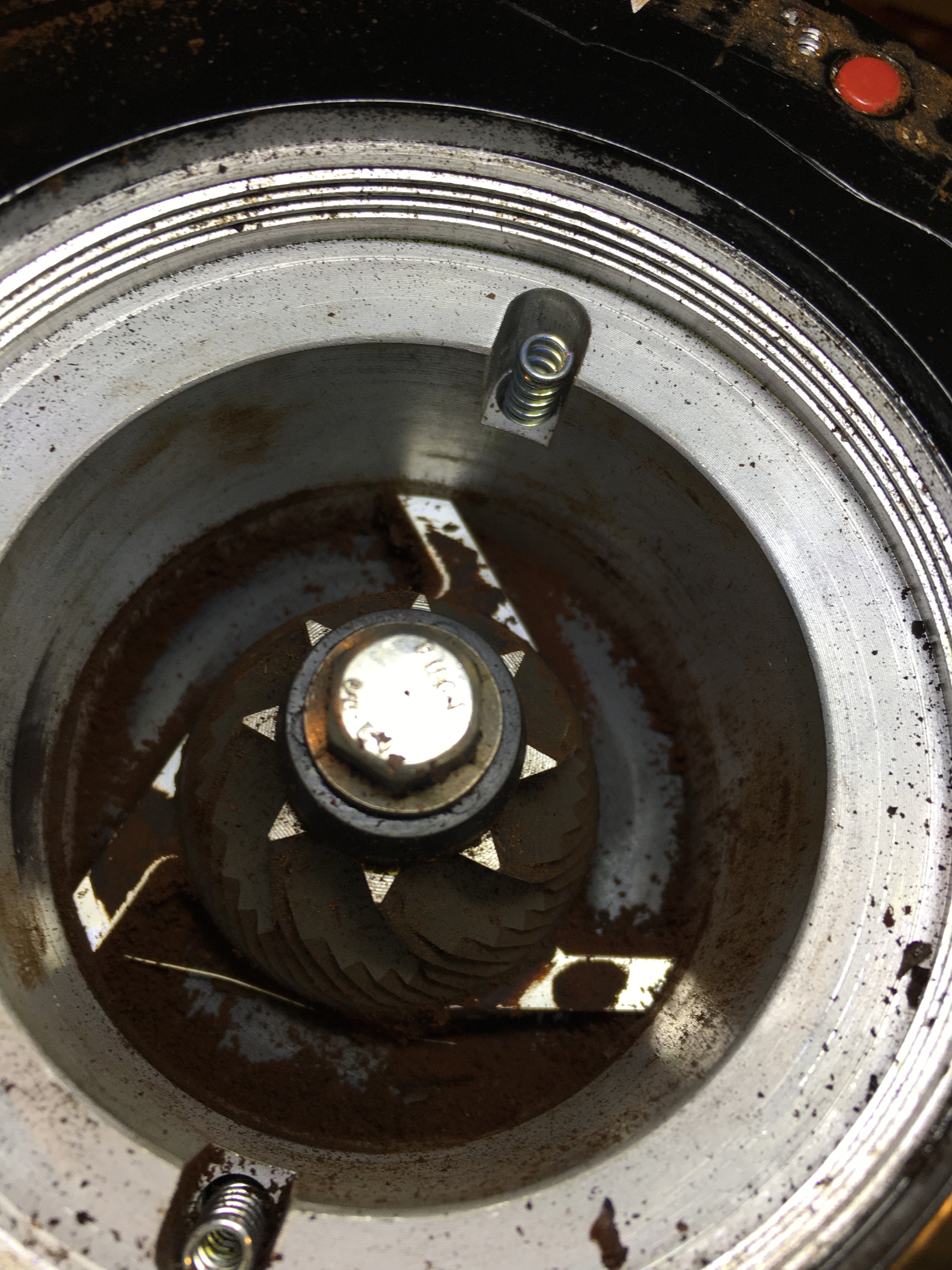
A view inside the grinding chamber reveals a small, efficient grinding chamber retaining about 0.5g of powder
The grinder is also whisper quiet. We are using it for our single origin Sidamo Dcaf which is a super star at Vivace. Of course this is a home grinder so no heat controls are in place. So far it handles ten shots/hour quite well with no heat issues however.