
David's Blog
Pico Perfection: Part Two
BY DAVID SCHOMER
SPECIAL TO BARISTA MAGAZINE ONLINE
After Synesso introduced PID in 2005, I focused entirely on grinding as the next frontier of improvement, and it became clear that two principal challenges emerged.
- Particle Control
One challenge the old dosers presented was the ability to maintain the exact distribution of fine particles within the powder on the way to the portafilter. We learned that any static en route would ruin the shot by pulling the fines out of place, so any free-floating powder left in the machine meant failure on this front, as well. Static mitigation does not work; the only way to preserve the integrity of the mix of particles is to impact them just enough enroute to trap the fines. The dosing system on La Marzocco’s Pico grinder does this perfectly by shooting the powder into the portafilter with spinning ramps, creating a “jet” of ground coffee.
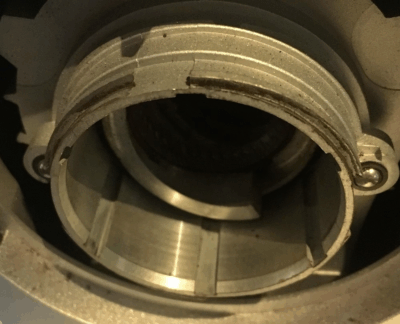
Ramps are positioned right at the burr set, resulting in instant impact on the ground coffee, thus trapping the fines and shooting the powder straight down into the portafilter. Therefore, there is no chance for static forces to affect the powder.
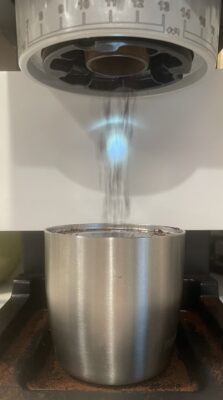
A close-up image of coffee grinds coming out of the Pico home espresso grinder by La Marzocco. The spinning ramps impact the ground coffee instantly as it exits the burr set, trapping fines in the mix with zero retained ground coffee.
- Chambered Coffee
No grinder had yet solved the problem of leftover grounds being trapped in the grinding head between shots. Roasted coffee still contains a little moisture, and chambered ground coffee instantly begins to absorb or expel moisture within the trapped powder. Ground coffee is wildly hygroscopic, i.e., it freely exchanges moisture with the ambient atmosphere.
Moisture content within the ground coffee affects the rate of flow of espresso from the group head. More moisture in the powder slows down the extraction; less moisture speeds up the pour.
It is hard to overstate the importance of controlling the rate of flow of espresso into the cup. This is intimately related to the final volume of the shot, of course. At my Seattle coffee company, Vivace, we favor a slow short shot, maybe 22ml extracted in about 35 seconds. This rate of flow and ristretto volume maximizes caramelized sugars and origin flavors into the cup. Shot times that are too fast—say, less than 27 seconds to hit our ideal volume—will be sour/astringent and have less caffeine. Too slow of an extraction—over 40 seconds, for example—may be hollow, sour, or bitter.
The effect of flow rate is much more nuanced than simply saying good shots exist between 27 and 40 seconds. What is fascinating to me is the range of flavors that exist within the boundaries of a decent shot. There is a spectrum of flavor nuances from more fruity (faster pours) to heavier umami and body (slower pours).
Take an Ethiopian Sidamo natural, for example. As it is with most Ethiopian naturals, the shot will have a heavy body and thundering chocolate umami balanced with notes of berry in the finish. Faster flows for this coffee—around 30 seconds extraction time—may highlight malic acid in the final shot and offer more fruity flavors like stone fruit or berry. Slower flows—in the upper 30s—emphasize heavier body and more savory richness, and berry flavors may recede a bit.
A master barista is able to decide what flavors they want to emphasize for any given coffee they are serving. If Dr. Joseph John of Josuma Coffee, who is a very sophisticated lover of our espresso, comes into our shop and asks the master barista to up the berry flavor a bit in his Sidamo, they can easily fulfill the request by aiming for a 30-second pour.
Precise control of the flow rate reveals the impossible beauty of the espresso method of coffee brewing. Within each well-roasted coffee is a host of flavors that a highly skilled barista can reshuffle at will by controlling the flow rate. And of course, this can only be achieved if there is no ground coffee trapped in the grinder.
Note: If you can follow this article, you understand that all factors in creating an espresso—temperature, coffee freshness, a clean, well-maintained machine, and the barista’s technique—must be perfected to taste the nuances in flavors at each flow rate.
So, for 37 years, we have been guessing how much to purge the grinder to expel ground coffee that has been affected by moisture exchange, and ultimately throwing out lots of shots when we misjudge. (My DRM unit had 12g of chambered coffee trapped in the head and dosing chamber; the Niche Zero got it down to four grams). My baristas are exacting professionals, and guessing the condition of the trapped coffee has always been driving them nuts.
With the Pico you adjust the grind as needed, and all of the coffee at the new setting is what you were aiming for, absolutely no powder remaining in the grinder at the previous grind setting.
With the Pico, waste and guesswork are over. And the precise control of grind reveals a whole new dimension in profiling the coffee of your choice.
Dosage Control
Of course, the dosage of coffee impacts the flow rate of the espresso quite directly. I like to tell baristas in training that dosage control by feeling it with your finger is very difficult.
Weighing the powder as it grinds to an accuracy of 0.1g solves this dosage problem perfectly. I will try to couple the Pico with the Bluetooth scale made by Acaia, so keep an eye on Vivace’s Instagram.
Currently, the Pico does not contain a scale to weigh the powder and turn the grinder off at the desired gram setting.
Heat Control
The ground coffee ideally should be slightly warm exiting the grinder, about 95°F. But grinding by the cup, turning the hefty motor on and off constantly, creates a lot of heat. In this area, the stock Pico overheats very quickly, making it suitable only for home use. After about 12 sequential shots, the powder is about 110°F, and the shots thin out immediately.
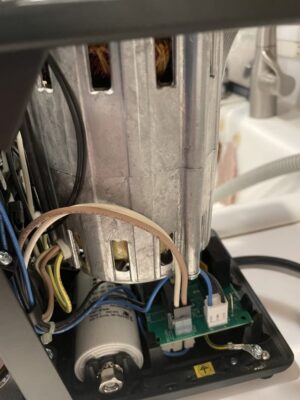
The little Pico is actually a beast! The motor feels powerful enough to drive a small golf cart. All this power results in heat building up very quickly in the grinding head, despite having a belt drive insulating the motor from the burr set.
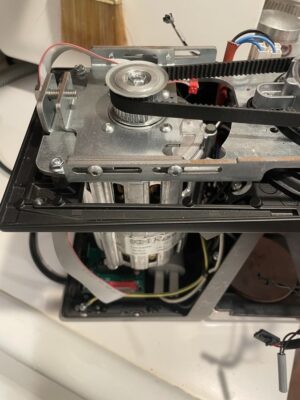
The rubber belt drive does not conduct heat. This makes the Pico a good candidate for DIY venting.
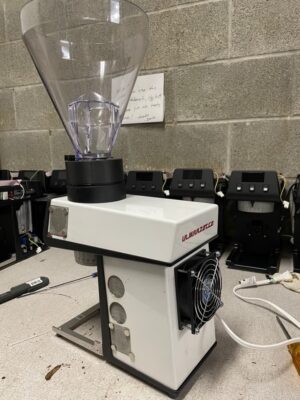
Our production Pico all tricked out. Vent positions are critical. Main body vents are down low and cut as far forward as possible. Note additional vents up near the grinding head.
The base of the hopper is well-designed to be removable without spilling beans; it automatically shuts when turned and lifted. A simple 3D printed collar mounts easily to accommodate our Mazzer bean hopper.
So far, my vented grinder is handling a medium commercial volume with a 55cfm fan and effective vent placement. Let’s see if it can keep cool at Brix on a Saturday—fingers crossed.
The Vivace baristas love the grinder. They hadn’t realized how difficult it had been to control flow rate before using the Pico. Now, they have a consistent grind right at the burr set with no purging. Each bean is absolutely fresh until it hits the portafilter. We have had virtually no compromised shots. And the grinder is quiet: It sounds like a gentle wind in the trees.
This grinder is the biggest improvement in the art of espresso since PID espresso machines. Having this grinder on my bar is a dream come true. In espresso and many other pursuits, perfect is the enemy of good. Humility is always required in the seduction of the bean, but may I say we are much closer than ever to each shot tasting like freshly ground coffee smells.
Pico Perfection: Part One
SPECIAL TO BARISTA MAGAZINE ONLINE
BY DAVID SCHOMER
Earlier this year, my longtime dream of pushing espresso into a consistent, repeatable culinary art form came true with the little Pico grinder from La Marzocco. After 37 years of frustration, for the first time in my life, the available equipment is not blocking me completely—or making it very difficult—to seduce the gorgeous fragrance of the bean into a cup.
When I began making espresso in 1987, the espresso machines available were incapable of maintaining stable temperatures during the extraction of the shot. This was a firm barrier to capturing the fragrance of the roasted coffee to savor as a taste and aroma experience. (That is the holy grail: espresso that tastes like the ground coffee smells.) Drifting temperature made that fragrant promise virtually impossible. That barrier fell on February 28, 2001, at La Marzocco in the Ballard neighborhood of Seattle. With the help of Kent Bakke, John Blackwell, Mark Barnett, Roger Whitman, along with John Bicht of Versalab, the first PID-controlled espresso machine came into existence. (See “Brewing Water Temperature ‘Italy Meets Omega,’” in LucidCafe, May 2001, authored by David Schomer; and “A Brief History of the PID,” by La Marzocco.)
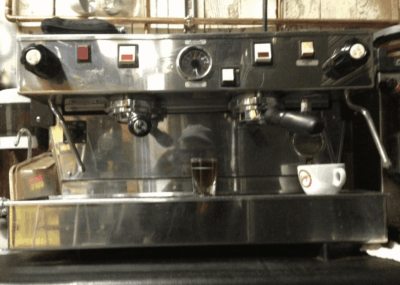
David Schomer’s custom La Marzocco Linea, featuring a PID and other modifications. Photo courtesy of La Marzocco.
Within a few years, PID control was a standard offering worldwide in modern espresso machines.
Espresso equipment, however, still needed help. The truly long slog was that of the grinder. I began writing articles 10 years ago explaining the features a grinder would need to be able to produce artisan espresso while grinding by the cup:
—No ground coffee shall be chambered in the grinder.
—Ground coffee must be delivered to the portafilter with no fine particle drift.
—A conical burr must be driven at the correct RPM to achieve ideal fines/coarse ratio.
—Heat generated by the motor must be controlled.
—Dosage must be measured by weight.
La Marzocco has hit the critical features with the Pico, whose features include RPM, direct dosing with no chambered coffee, and zero fine-particle drift. Grind by weight is optional for the artisan barista and not yet available. Heat control is the big differentiator with this grinder; DIY venting solutions are possible. With the release of the Pico, I can say that after 37 years, we have access to espresso perfection.
A Little Background
On a walk with my son on Seattle’s Fremont Canal in 1992, I dreamed of a grinder that would be made especially for grinding each shot freshly, per order. Grinding on demand put a unique strain on the motor: Early on, I understood that too much heat, generated by turning the motor on and off for each dose, was a problem. But I also recognized the importance of freshness in the grounds being dosed into the portafilter.
So you can see that the grinder has been an area of constant research for me. To assist me on my quest, La Marzocco legend Kent Bakke began importing grinders for me to test beginning in the mid-1990s. Therefore, it’s especially poignant that La Marzocco is the company that has finally solved the dilemma 30 years later.
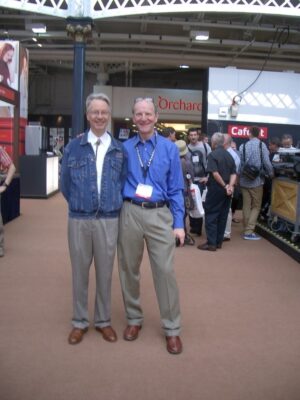
David Schomer (left) of Espresso Vivace and Kent Bakke of La Marzocco, circa 2003. Photo courtesy of David Schomer
The Dosing System
The keys to controlling the espresso’s flow rate are grind integrity combined with exact coarseness. This results in precise resistance of the grounds to the pressurized water, therefore achieving the perfect, oozing extraction.
Because the Pico does not retain any ground coffee in the chamber, the powder remains unaffected by moisture exchange with the ambient humidity conditions. (See: Chambered Coffee, in part two.)
And the Pico’s dosing system has twin ramps, shooting the coffee downward instantly as it exits the burr set. This is critical: It prevents any micro particle migration within the powder en route to the portafilter. (See: Particle Control, in part two.)
Ring Burr Drive
The placement of the burrs in the jet-style dosing configuration requires the manufacturer to drive the ring burr with the motor. This dramatically increases the efficiency of the grind, resulting in more flavor and thicker crema than the same burr set driving the cone burr, with the motor at the same RPM. Currently the cone burr drive is still standard on all conical grinders except those using jet-style dosing.
RPM
My research clearly shows there is a Goldilocks zone (i.e., too much, too little, or just right) for the RPM when using conical burrs and driving the cone burr with the motor. With the Kony burr (40mm) RPM is about 300. The espresso produced is thick and rich, with a satin mouth feel. I have tested grinders turning the conical burr set as low as 150 RPM and the espresso is thin, like flat burr extractions. Similarly, driving the conical burrs at high RPMs also resulted in thin shots.
The Pico is turning the ring burr at 800 RPM, resulting in about 17 seconds of grinding time for a 22g dose. Turning at about 300 RPM, the Kony burr’s grinding time is in the 15-second range. Microscopic evaluation revealed a significantly higher percentage of fines in the powder produced by the Pico than the Kony at 300 RPM. However, the increase of fines in the mix that gives you such thick shots presents its own challenges for the barista. The Pico demands vigorous distribution techniques to avoid brewing water channeling through the packed coffee.
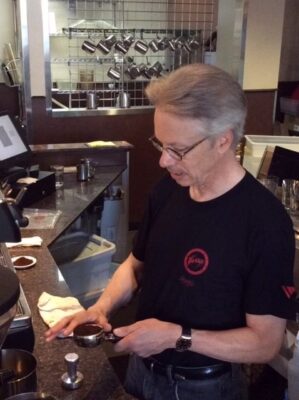
David at work grinding coffee at Espresso Vivace in Seattle.
All my experiments are on grinders turning the cone burr with the motor. However, driving the ring burr with the motor is a whole new animal. I have no data on the ideal RPM for the ring burr drive. However, the Pico grinder is turning the ring burr at about 800 RPM, resulting in a grind time of about 17 seconds for a 20g dose. At 800 RPM, driving the ring burr, the Pico produces a high percentage of fines and delivers them into the portafilter with perfect fidelity. Additional fines in the powder results make it possible to produce the thickest, most intensely flavorful espresso I have ever had.
Roasted Coffee-what you need to know
Dear Constant Reader,
Roasted coffee is changing constantly after roasting. The noble aromatics are fragile and need proper storage to survive into the cup. As I have said so often “no chef can rise above their raw materials”. Expert marination cannot save spoiled fish…Here is an overview of the situation starting at bagging fresh coffee, one hour after roasting…
De Gas the Coffee
Roasting is a Maillard reaction generating heat, CO2, caramelized sugars and hundreds of volatile aromatic substances. The CO2 must be allowed to out gas to achieve a full flavor cup. 85% of the CO2 comes out in the first ten hours but coffee brewed one day after roasting can still have sharp note due to the gas being present. Coffee is servable two days after roasting but flavors will peak after five days given proper storage!
Storing Roasted Coffee
Refrigerate immediately for a 30 day preservation of your coffee. To put it more succinctly, what ever condition your roasted coffee is in refrigeration will preserve any volatile compounds remaining in the coffee for 30 days. Refrigeration cannot revive damaged coffee, only preserve it as is.
Coffee stored in a dark place at room temperature will last ten days, max.. Coffee experiencing temperatures above that will perish very quickly. This has implications for shipping especially in the summer months. (Coffee in the cargo bay of a jet at Narita Airport in the summer will be totally ruined in about one hour at temperatures above 90 degrees F.!)
Roasted coffee is incredibly temperature sensitive.
We are not sure about freezing it yet…
Brewing roasted coffee
Bring your coffee beans to room temperature before grinding. Coffee will be richer, and in the case of espresso have a fuller body and mouth-feel, at 70 degrees F. (What I do at home is to remove my morning coffee beans from the ‘fridge into the grinder so they are stable at room temperature the following morning).
Packing for Espresso-35 years later
Dear Reader,
When we opened in 1988 I toured Italy twice to study extraction techniques and equipment. One of the takeaways was the hand position and tool for espresso packing. We trained on scales for years and I thought the straight arm and wrist position I has seen in Italy , combined with 40 pounds maximum force, would be sufficient to avoid long term injury.
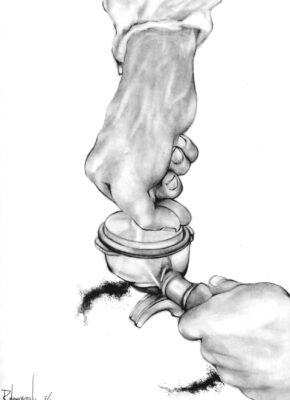
I was wrong. As baristi pass the 20 year mark on daily shifts, some have developed wrist or shoulder injuries from packing the coffee by hand. And as for myself, at the 35 year mark of packing by hand…I developed wrist problems.
So I am recommending two packing machines.
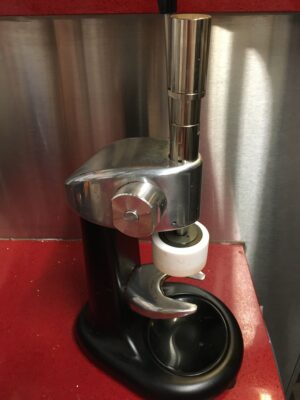
Mechanical hand packer from Italy. This works but still requires a repetitive, forceful lever pull to achieve packing. The repetitive nature of the activity will probably result in tendon and ligament problems also.
Enter the PUQ press…
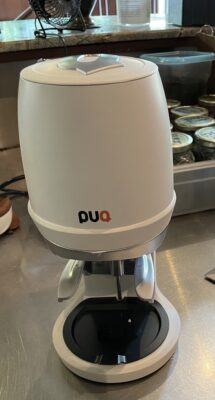
We have used this for about one month. It can be made to pack at a force of your choosing, we set it at 40 pounds. It has a few tricks up it’s sleeve however. Here is what we have learned:
For our naked porta-filter (PF), you need to adjust the height of the bracket that holds the PF in place as tightly as possible. Even after doing that check your level with a hand packer and adjust your usage angle if needed by lifting the PF handle at the moment of packing. If the pack is not level the pour will be off center, not good.
Ground coffee will accumulate on the piston surface and we wipe it every few shots with a rag.
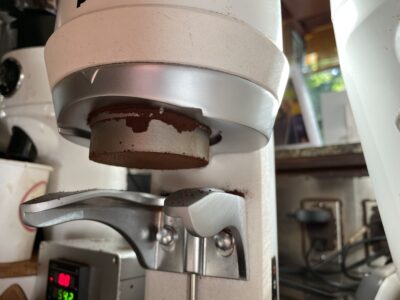
Ground coffee will also accumulate on the sides of the piston and may enter the motor enclosure and ruin the machine over time. There is a cleaning button on the control panel to lower the piston as shown in the picture. We wipe this about once every hour.
I never expected staff to run the front bar for more than a few years but several Vivace veterans have reached that point. Not all of them have developed problems from packing but I have switched to the PUQ anyway. We went with the GEn 5 Q2 model and it is capable of hundreds of shots a day.
Agora Refreshments is a Seattle Vivace distributor!
Dear Reader,
For years different organizations have approached us to distribute our Northern Italian roast. I say “great but the coffee must be in the customers hands within three days of roasting”. They become strangely quiet at that point. But finally, I have found one that truly respects our bean! I am excited to announce that Agora does deliver truly fresh Vivace coffee to offices in the Seattle area. We even created an “Agora Blend” for them!
Check them out at www.agorarefreshments.com
-David
Bourbon Pointu-34th Anniversary Offering
Vivace 34th anniversary espresso tasting
This year David will personally prepare one of the rarest coffee cultivars in the world: Mexican Bourbon Pointu
Bourbon Pointu, like most coffee varietals, was a natural mutation in the coffea arabica plant. Pointu features a natural sweetness and 40% less caffeine than other arabica typicas. For the bush, caffeine repels insects naturally so farmers abandoned this varietal due to the difficulty of growing it. It almost became exinct except for one micro-lot farm in the Chiapas region of Mexico. In fact only 20 bags are available annually and Vivace bought 15 bags for you! (Thank you to the representative of Chiapas farms, Luis Gomez Andere!)
Truly I’m very excited about this coffee. In the cup it features a medium body, a savory caramel, a hint of black pepper, and a sweetness that reminds me of effervescent cola. Let me make you a shot…
Thursday April 14th 12 to 2:30pm Alley 24
Friday April 15th 12 to 2:30pm at Brix
Featured coffees also include
Ugandan Ekende and
Swiss Water Dcaf Sidamo

Pointu refers to the shape of these tiny beans
In Praise of Mexican Microlot Coffee
Dear Patient Reader,
With Ethiopia experiencing civil war and extended drought conditions, I began to search for coffees that might be able to match the quality I have enjoyed for years at Vivace. Coffees from the Sidamo, Yirgacheffe, Harrar, and Guji regions of Ethiopia have been unmatched for flavor intensity, body, notes of blueberry, and a savory quality that emerges in our roast when prepared as espresso.
I have been terrified that Ethiopian coffee might be unavailable in the not too distant future. Thanks to the efforts of Luis Gomez Andere of Chiapas Mexico, salvation has appeared in the Mexican micro-lot farms in the region. (Luis company is Roasters Warehouse Trading Company).

Luis and David hang out at Alley 24
Luis explained to me that leaf rust had decimated many larger Central and South American coffee farms. However smaller farms were able to hand trim affected parts of the plant saving the farms. This small, focused way of farming also produces very high quality in the cup. Individual attention by the farmers to soil composition, proper water management, and unique processing gives them an edge over massive farms located throughout the Americas.
In fact, Ethiopian farmers made a trip to the Chiapas region to study the processing methods employed by these small farms.
Here are our tasting notes for some of these coffees offered on Sundays at Vivace’s single origin program…
Estate Huehuetepan ,
Processed with Anaerobic Fermentation, a process of sealing the coffee cherries in an air tight container while fermentation of the mucilage of the cherry occurs, imparting (hopefully) pleasing notes to the coffee after drying. The farm is located in Veracruz Mexico. When prepared as espresso it features a medium body with active citrus notes and a pleasing caramel.
Mexican Pacamara
Grown at Finca Muxbal on the slopes of an active volcano, (Tacana) at 4060 meters asl. Espresso featured a medium body with notes of nutmeg up front, a caramel umami, and light stone fruit in the finish. Very unique coffee…
Mexican Bourbon Pointu
A bourbon is a sub-species of coffea arabica which originated on Bourbon Island, (renamed Reunion Island). Pointu refers to the shape of these tiny coffee beans. A unique note of black pepper combined with a effervescent cola sweetness, makes this one of the most interesting coffees we have offered. Lower caffeine content compared to most arabicas offers and easy drinkability and reduces bitterness.
Schomer Consultation
Hello Espresso Lovers,
I’m ready to teach your company how to create the most flavorful and beautiful caffe espresso and latte art. Three days with me and I guarantee you will be making the finest espresso in your city.
In this intensive format I will be:
-Evaluating and tuning equipment for perfection.
-Training baristi on specific techniques, (and training your trainer to ensure the information is retained and a culture of excellence is created in your company.)
-Presenting my theory lecture live to cover every aspect of creating this culinary art
In my thirty three years of training and developing this into a culinary art I have written over 100 trade articles, produced three video courses, and written the seminal book series “ESPRESSO COFFEE Professional Techniques” in 1995 and updated as new information and equipment is discovered. These materials and research are widely credited with starting the world-wide trend to prepare caffe espresso as a culinary art.


“David Schomer has changed the way the world makes espresso” “The Art of Perfection” Green Coffee Review Dec. 2015
Consulting Bewley’s of Ireland-1998
“We met David on a research trip to Seattle and persuaded him to come to Ireland and do a week of consulting in the form of Espresso Workshops & Keynotes. It was a revelation. The influence was enormous. The language inspiring. The lights had come on and not just for me. Industry stalwarts were stunned such was his impact.”
“David was the American Irish coffee revolutionary we had all been waiting for. He was hands down my biggest influence and his legacy remains today. A legend.”
Hugh Gilmartin-The Filter Business Consultancy, Belfast Ireland
To apply please email me directly. I would like to chat on Zoom to allow you to get to know me and see if we “click”. I will need a sample of your roast, and a list of your equipment. If I can help you we can proceed with scheduling.

ESPRESSO PERFECTION is on sale now
Dear Espresso Lovers,
ESPRESSO PERFECTION
Preparing caffe espresso as a culinary art
By David C. Schomer
Available Friday March 19th in our stores and online at www.espressovivace.com
Caffe espresso has revealed so many new secrets since I released “ESPRESSO COFFEE 2013” I felt compelled to revisit and greatly expand the information in the book. I can say truthfully I am very happy with this edition.
I have done a deep dive into theory and practice to prepare this as a culinary art. Of particular note is the explanation of requirements for demand grinders. If you have been following my work you know that dosing the coffee into the porta-filter has emerged as the toughest problem for these grinders. I will explain here two dosing solutions for grinders that currently exist. And, I have added new theory, and for the first time explained the appearance of sweet espresso shots.
Price $35
COFFEE FRESHNESS-Update
Hello Coffee Lovers,
For the past three days I have enjoyed our Vita blend that was roasted on February 8th! (It is March 9th today) The coffee was very good. I have tested several refrigerated samples in the last two weeks and I’m ready to state that with proper handling our roasted coffee stays perfect for one month in the refrigerator!…here is exactly what I did for this test. (Samples included Ugandan Ekende, Vita Blend and Dolce Blend.)
In all test batches the beans were held at room temperature, at or below 70 degrees F. for two or three days to simulate shipping conditions that our coffee will go through for online orders, then placed in the refrigerator and held around 45 degrees in the original bags. Shots featured full flavor and viscosity with normal crema production.
From personal experience I know that coffee is very temperature sensitive so I’m not sure this will apply to the summer months. It will depend on the temperatures the coffee is exposed to during shipping.